This is the crash course on Yuneta’s runtime. At the end you know what a gobj is, what a gclass is, how to declare one, how the framework calls into it, how the runtime tree is laid out, and where the sharp edges are.
Conceptual frame. This document describes the behavior plane of Yuneta’s typed-graph model. The information plane is in
YUNO_TREEDB.md. The claim that both planes share one set of primitives —gclass/topic,gobj/node, subscription/hook— is laid out in The Typed-Graph Model. Read that first if you want to know why gobj and treedb look so similar before diving into either one.
Sibling to YUNO_LIFECYCLE.md, DEBUGGING.md,
IPC.md, REALMS.md, SCAFFOLDING.md,
YUNO_AUTH.md. Events and message dispatch are already covered in
detail in IPC.md — this doc only sketches the bits needed to
understand the lifecycle.
1. The two halves: gclass vs gobj¶
| Concept | Role |
|---|---|
| gclass | The class (in the OO sense). Static, registered once at process start. Declares attrs, FSM (states + events + actions), command table, methods. Examples: C_TIMER, C_TCP_S, C_AUTH_BFF. |
| gobj | A runtime instance. Created by gobj_create*, lives in a tree, holds a priv data pointer, has an FSM state, a running/playing flag, subscriptions, and more |
A gclass declares mt_* framework methods (next section). A gobj is the
object on which those methods get called. The gclass struct lives in
read-only data. One gobj instance per gobj_create* call lives on the
heap with its own priv.
In source files, by convention:
kernel/c/root-linux/src/c_timer.c    ← the gclass
                       c_timer.h     ← public registration entry
A gclass file always exposes exactly two public symbols (CLAUDE.md hard
rule, feedback_gclass_public_interface):
GOBJ_DECLARE_GCLASS(C_TIMER);
PUBLIC int register_c_timer(void);
Everything else (commands, attrs, events, lmethods, stats) is reached through the standard framework APIs.
2. The shape of a gclass file¶
Every gclass conforms to the gclass_service or gclass_child skeleton
(see SCAFFOLDING.md §6). The banner order is not
optional (CLAUDE.md “GClass templates and skeletons”). At a glance, in
the order they appear in a file:
        ┌─────────────────────────────────────┐
        │           PRIVATE DATA              │ ← typedef struct PRIVATE_DATA { … } PRIVATE_DATA;
        │                                     │   Per-instance C state held in priv pointer.
        └─────────────────────────────────────┘
        ┌─────────────────────────────────────┐
        │             ATTRIBUTES              │ ← const sdata_desc_t attrs_table[] = { … };
        │                                     │   Typed schema of every attr the gclass exposes.
        └─────────────────────────────────────┘
        ┌─────────────────────────────────────┐
        │       FRAMEWORK METHODS (mt_*)      │ ← mt_create, mt_start, mt_stop, mt_destroy, …
        └─────────────────────────────────────┘
        ┌─────────────────────────────────────┐
        │              COMMANDS               │ ← const sdata_desc_t command_table[] = { … };
        │                                     │   cmd_xxx() handlers
        └─────────────────────────────────────┘
        ┌─────────────────────────────────────┐
        │            LOCAL METHODS            │ ← const sdata_desc_t lmt_table[] = { … };
        │                                     │   lmt_xxx() handlers
        └─────────────────────────────────────┘
        ┌─────────────────────────────────────┐
        │              ACTIONS                │ ← ac_xxx() FSM action functions
        └─────────────────────────────────────┘
        ┌─────────────────────────────────────┐
        │     EVENTS / STATES / GCLASS REG    │ ← event_types[], states[], create_gclass()
        └─────────────────────────────────────┘
Empty sections still get their banner. Do not reorder them.
3. The framework method table (GMETHODS)¶
Declared in gobj.h as gobj_method_t. The framework calls
these on your gclass at fixed points in the lifecycle. None is required. A
gclass with zero methods is valid, and it is a data bag. In practice you
always implement mt_create and mt_destroy at minimum. Add mt_start and
mt_stop if you have runtime resources.
These are the most useful ones, in the order in which you write them:
| Method | When the framework calls it | What you typically do |
|---|---|---|
mt_create(gobj) | After the gobj is allocated, attrs initialized, but before mt_child_added on the parent | Cache attrs into priv, configure the CHILD/SERVICE subscription block (see SCAFFOLDING.md §6) |
mt_create2(gobj, kw) | Alt to mt_create when you need the raw kw of the creation call | Same as above, plus kw-driven config |
mt_destroy(gobj) | After the gobj is stopped, paused, and all children are already destroyed | Free resources not owned by children |
mt_start(gobj) | gobj_start() flips running=TRUE (gobj.c:4311) then calls this | Start timers, subscribe to peers, open sockets |
mt_stop(gobj) | gobj_stop() flips running=FALSE then calls this | Stop timers, unsubscribe, close sockets |
mt_play(gobj) / mt_pause(gobj) | gobj_play() / gobj_pause() | Gate input processing (see YUNO_LIFECYCLE.md §4.4) |
mt_writing(gobj, name) | After gobj_write_*_attr() succeeds | Sync priv->field from the attr, validate it, and react |
mt_reading(gobj, name) | Inside gobj_read_*_attr() | Return a computed value — required for SDF_RSTATS counters |
mt_child_added / mt_child_removed | When children are created/destroyed | Track child references, wire subscriptions |
mt_subscription_added / mt_subscription_deleted | When someone subscribes to your events | Send initial state, clean up per-subscriber resources |
mt_inject_event(gobj, ev, kw, src) | When gobj_send_event finds no row in the state table | The escape hatch — handle the event yourself, or fail |
mt_command_parser | When a command is invoked but not in command_table | Custom command dispatch (rare. Only the agent uses this for command-yuno forwarding) |
mt_authz_checker | Inside gobj_user_has_authz if installed (gobj.c:9400) | Per-gclass authz hook — see YUNO_AUTH.md §4.3 |
The full table is in gobj.h. It has more than 28 slots, among them
mt_create_resource, mt_save_resource, mt_create_node and
mt_link_nodes. Most gclasses use less than 10 slots.
4. The lifecycle, step by step¶
                                gobj_destroy()
                              ┌─────────────────┐
                              │                 │
                       ┌──────▼────────┐    ┌───▼─────────┐
   gobj_create() ────► │   CREATED     │    │  DESTROYED  │ ← terminal
                       │ obflag_created│    └─────────────┘
                       └──────┬────────┘
                              │ gobj_start() or gobj_start_tree()
                              ▼
                       ┌────────────────┐
                       │   RUNNING      │ ← mt_start() ran
                       │ running=TRUE   │
                       └──────┬─────────┘
                              │
                              │ gobj_play() / gobj_pause() — orthogonal
                              │
                              ▼
                       ┌────────────────┐
                       │   PLAYING      │ ← mt_play() ran
                       │ playing=TRUE   │
                       └──────┬─────────┘
                              │ gobj_stop() or gobj_stop_tree()
                              ▼
                       ┌────────────────┐
                       │   STOPPED      │ ← mt_stop() ran
                       │ running=FALSE  │
                       └────────────────┘
Important code points:
gobj_create()(gobj.c:1804): allocate, init attrs, setobflag_created, callmt_create(), then call parent’smt_child_added().gobj_start()(gobj.c:4311): setrunning=TRUEbefore callingmt_start(). Inside yourmt_start,gobj_is_running(gobj)already returnsTRUE.gobj_stop()(gobj.c:4464): setrunning=FALSEbefore callingmt_stop(). Symmetric.gobj_destroy()(gobj.c:2272): pauses + stops if needed, unsubscribes the gobj from everyone, destroys all children, then callsmt_destroy(). That ordering is whymt_destroycan safely touch resources without checking child state.The pause/stop happen before
obflag_destroyinggoes up, and that is deliberate.gobj_stop()refuses a gobj that is already destroying, because nothing outside can stop a gobj that the framework dismantles. With the flag up first, the rescue therefore dies on that guard andmt_stopnever runs. That is what happened until 7.9.4. A destroy of a live gobj still logs “Destroying a RUNNING gobj” with a stack trace, because it remains your bug: callgobj_stop_tree()beforegobj_destroy(). The framework repairs the error. It does not accept it.
4.1 gobj_start_tree vs gobj_start¶
gobj_start_tree(gobj) (gobj.c:4429) walks the gobj’s subtree and
starts every child too — except ones marked with the
gcflag_manual_start gclass flag. Most CHILD-pattern gclasses do not
set that flag, so they get started automatically.
The gobj_create_pure_child gotcha (memory
feedback_gobj_js_gotchas):
gobj_create_pure_child() marks the new gobj with
gobj_flag_pure_child, and some constructors also imply
gcflag_manual_start. If your pure child does nothing after creation,
you almost certainly forgot to call gobj_start(child) explicitly. Or
use gobj_start_tree(parent) if you want the whole subtree started in
one shot.
4.2 gobj_create* flavours¶
| Constructor | What you get |
|---|---|
gobj_create(name, gclass, kw, parent) | Plain child. Standard case. |
gobj_create2(name, gclass, kw, parent, flag) | Same + explicit gobj_flag_*. |
gobj_create_yuno(name, gclass, kw) | The root. One per process. Sets gobj_flag_yuno. |
gobj_create_service(name, gclass, kw, parent) | A service — discoverable by name, autostartable. |
gobj_create_default_service(name, gclass, kw, parent) | Like _service but the yuno calls gobj_play() later. |
gobj_create_volatil(name, gclass, kw, parent) | Temp child — destroyed when its parent is. |
gobj_create_pure_child(name, gclass, kw, parent) | CHILD-pattern child. Needs explicit gobj_start (or gobj_start_tree(parent)). |
When in doubt: services for things addressable by name from other yunos/the SPA, pure children for protocol stacks and per-connection helpers, plain children for everything else.
5. Attributes via SData¶
A gclass declares its attributes in a const sdata_desc_t attrs_table[]
array, terminated by SDATA_END(). Each row is a typed schema:
SDATA(type, name, flag, default_value, description)Three things to know:
5.1 The types (gobj.h)¶
DTP_* | Concrete C / JSON type |
|---|---|
DTP_STRING | const char * |
DTP_INTEGER | json_int_t (64-bit) |
DTP_BOOLEAN | BOOL (0 / 1) |
DTP_REAL | double |
DTP_JSON | json_t * (any JSON value) |
DTP_DICT | json_t * (JSON object) |
DTP_LIST | json_t * (JSON array) |
DTP_POINTER | void * (opaque) |
DTP_SCHEMA | Sub-schema (commands’ parameters) |
5.2 The flags (gobj.h)¶
The ones that matter most often:
| Flag | Effect |
|---|---|
SDF_RD | Reads allowed. Writes denied. |
SDF_WR | Writes allowed (implies SDF_RD). The only flag write-attr accepts. |
SDF_REQUIRED | Must not be null at creation time. |
SDF_PERSIST | Survives a yuno restart. Loaded on mt_create if persistence backend is installed. Not writable by write-attr without SDF_WR (it was up to 7.25.22). |
SDF_VOLATIL | Set by the framework or by other gclasses on this gobj. Read-only from user code. |
SDF_STATS | Treated as a statistic for stats output. |
SDF_RSTATS | Resettable stat — requires mt_reading wired to compute on read. See feedback_mt_reading_for_rstats. |
SDF_PSTATS | Persistent stat (combination of SDF_PERSIST + stat semantics). |
SDF_DEPRECATED | Logged-warning attribute, still accepted (see c_authz’s authz_yuno_role). |
SDF_AUTHZ_R / SDF_AUTHZ_W / SDF_AUTHZ_X / SDF_AUTHZ_S / SDF_AUTHZ_RS | Demand the matching authz. ⚠️ Currently not enforced for commands (see YUNO_AUTH.md §4.5). |
SDF_SECRET | A password, client secret or token: read and persisted as usual, shown as ******** by view-attrs, write-attr, list-persistent-attrs, view-gobj, view-config and the create_delete2 trace (since 7.25.19, gobj_mask_secret_attrs()). |
5.3 The R/W API¶
gobj.h. Typed accessors:
const char *  gobj_read_str_attr     (hgobj gobj, const char *name);
json_int_t    gobj_read_integer_attr (hgobj gobj, const char *name);
BOOL          gobj_read_bool_attr    (hgobj gobj, const char *name);
double        gobj_read_real_attr    (hgobj gobj, const char *name);
json_t       *gobj_read_json_attr    (hgobj gobj, const char *name);   // not owned
void         *gobj_read_pointer_attr (hgobj gobj, const char *name);

int           gobj_write_str_attr    (hgobj gobj, const char *name, const char *value);
int           gobj_write_integer_attr(hgobj gobj, const char *name, json_int_t value);
…
Plus bulk APIs:
gobj_read_attrs(gobj, include_flag, src)(gobj.c:3546) — returns a JSON object with every attr matchinginclude_flag. Recently patched to route throughmt_reading(memoryproject_gobj_read_attrs_fix, 2026-05-22) soSDF_RSTATScounters now show their live values in bulk reads. Same fix mirrored in the JS side.gobj_write_attrs(gobj, kw, include_flag, src)(gobj.c:3622) — bulk write.
5.4 SDF_PERSIST storage¶
The framework hands SDF_PERSIST attrs to a pluggable backend registered at
startup. The default backend writes them under the yuno’s data directory.
The load is automatic, and it does not go through the public API. The chain, top to bottom:
entry_point.c:83picks the default backend,db_load_persistent_attrs(dbsimple.c). A yuno can replace it through thepersistent_attrsargument ofyuneta_entry_point().gobj_start_up()stores it in__global_load_persistent_attrs_fn__(gobj.c:553).gobj_create()calls that pointer itself (gobj.c:1748) for a gobj flaggedgobj_flag_serviceorgobj_flag_top_service— afterwrite_json_parameters(), beforemt_create. It passeskeys = 0, which means every key in the file.db_load_persistent_attrs()reads the file and applies it withgobj_write_attrs(gobj, attrs, SDF_PERSIST, 0). That flag mask is the real filter: the file may hold anything, only attrs declaredSDF_PERSISTare written.
So a service gets its persistent attrs before its own mt_create runs,
and a non-service gobj never gets any.
The file is one per gobj, named
<GCLASS_NAME>-<gobj_name>-persistent-attrs.json, under the realm’s data
subdirectory (yuneta_realm_file(..., "data", ...)). A missing file is not an
error: the load returns 0 and the attrs keep their SData defaults. It is
0600 (it can hold a secret), and a save writes a new file and renames it over
the old one, so a save that fails leaves the old file as it was (write-attr
answers that failure). In a data directory the yuno cannot write the save goes
in place instead, which a crash during the write can leave unparsable. The
whole story (owners, unreadable files, the in-place path) is in
db_save_persistent_attrs().
APIs (gobj.c):
gobj_save_persistent_attrs(gobj, jn_attrs)— call after mutating aSDF_PERSISTattr you want to checkpoint immediately. Always name the attrs; the bare call saves them all.gobj_load_persistent_attrs(gobj, jn_attrs)— reload a subset by name. Nothing in the tree calls it, because step 3 already loaded everything at create time. It is there for a gobj that wants to discard its in-memory values and re-read some of them.
Both refuse a gobj that is not a service, with a warning and -1.
Example from c_yuno.c:
SDATA(DTP_STRING,  "url_udp_log", SDF_PERSIST, "",  "UDP Log url"),
SDATA(DTP_STRING,  "process",     SDF_RD,      "",  "Process name"),
SDATA(DTP_STRING,  "hostname",    SDF_PERSIST, "",  "Hostname"),
SDATA(DTP_STRING,  "__username__",SDF_RD,      "",  "Username"),
SDATA(DTP_INTEGER, "pid",         SDF_RD,      "",  "pid"),
SDATA(DTP_STRING,  "node_uuid",   SDF_RD,      "",  "uuid of node"),
SDATA(DTP_STRING,  "realm_id",    SDF_RD,      "",  "Realm id"),
6. The runtime tree¶
A process is one yuno = one root gobj = __yuno__. Everything else
descends from it. The structure looks like this in production:
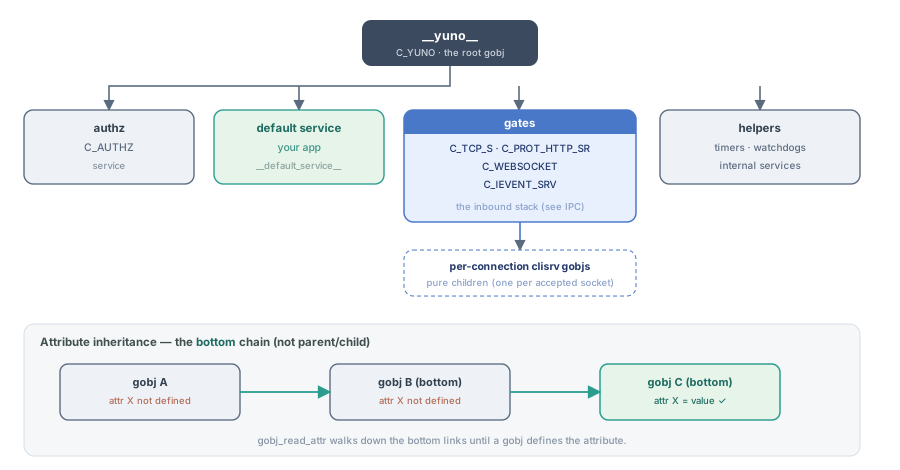
The same tree in text:
            __yuno__   (gobj_flag_yuno, C_YUNO instance)
                │
       ┌────────┼────────┬────────────────┐
       │        │        │                │
       ▼        ▼        ▼                ▼
     authz   default   gates           helpers
   (service)  service  (e.g. C_TCP_S    (timers, watchdogs,
   C_AUTHZ   (your    + C_PROT_HTTP_SR  internal services)
              app)     + C_PROT_WEBSOCKET
                       + C_IEVENT_SRV)
                       │
                       └─ per-connection clisrv gobjs (pure children)
Navigation helpers (gobj.c):
| Function | Purpose |
|---|---|
gobj_yuno() | The root gobj. __yuno__ global. |
gobj_parent(gobj) | Immediate parent. |
gobj_child_by_name(gobj, name) | First child with that name. |
gobj_child_by_index(gobj, idx) | 1-based index. |
gobj_first_child(gobj) / gobj_next_child(child) | Iterate linearly. |
gobj_child_size(gobj) | Count. |
gobj_walk_gobj_children(gobj, walk_type, cb, ud, ud2, ud3) | Tree walk with callback. |
gobj_find_gobj(path) | Lookup by full path, for example "__yuno__\auth`bff"`. |
gobj_bottom_gobj(gobj) / gobj_set_bottom_gobj | The downward layering pointer (see IPC.md §6.5). |
Identification helpers (gobj.c):
const char *gobj_name(gobj);                    // instance name
const char *gobj_gclass_name(gobj);             // gclass name ("C_TIMER")
const char *gobj_short_name(gobj);              // "gclass^name"
const char *gobj_full_name(gobj);               // full path
const char *gobj_yuno_role_plus_name();         // current yuno's role+name (used in command response prefixes — see feedback_build_command_response_yuno_prefix)
Predicates (gobj.c):
BOOL gobj_is_running(gobj);
BOOL gobj_is_playing(gobj);
BOOL gobj_is_disabled(gobj);
BOOL gobj_is_service(gobj);
BOOL gobj_is_pure_child(gobj);
6.1 The service registry¶
__jn_services__ (a global dict at gobj.c) maps service name →
gobj pointer, case-insensitively. Three special names always resolve:
| Name | Resolves to |
|---|---|
__yuno__ / __root__ | The root gobj (gobj_yuno()). |
__default_service__ | The yuno’s default service (the first gobj_create_default_service). |
Public API:
hgobj gobj_register_service(hgobj gobj, const char *service_name);
hgobj gobj_find_service(const char *service_name, BOOL verbose);
hgobj gobj_find_service_by_gclass(const char *gclass_name, BOOL verbose);
This is also how the ievent layer routes a remote command call to the
right local gobj — see IPC.md §4.5.
6.2 The priv pointer¶
Every gobj has a void *priv for the gclass’s private C state. Access
with gobj_priv_data(gobj). Pattern at the top of every action:
PRIVATE int ac_timeout(hgobj gobj, gobj_event_t event, json_t *kw, hgobj src)
{
    PRIVATE_DATA *priv = gobj_priv_data(gobj);
    …
}
You do not allocate it. The framework allocates it, with the size that the
priv_size argument of create_gclass() gives.
6.3 The obflag lifecycle bits¶
| Bit | Meaning |
|---|---|
obflag_created | mt_create returned. Object usable. |
obflag_destroying | gobj_destroy started. Do not subscribe or send. |
obflag_destroyed | mt_destroy returned. Object inert. |
If you hold a raw pointer and you need safety, check
gobj->obflag & obflag_destroyed. The better answer is do not hold raw
pointers across lifecycle boundaries. See §8.5.
7. Worked example: c_timer.c¶
The minimal canonical gclass per CLAUDE.md. 415 lines, single state, two events, one action. Open the file next to this text. Every Yuneta C developer must be able to read it without preparation.
7.1 What it does¶
c_timer.c is a periodic / one-shot timer. The gclass listens to the
yuno’s global EV_TIMEOUT_PERIODIC heartbeat and republishes its own
EV_TIMEOUT (one-shot, then auto-stop) or EV_TIMEOUT_PERIODIC (every
msec).
Its whole contract is two calls, and it is worth stating before reading a line of it:
set_timeout(timer, 1000);   // arms
clear_timeout(timer);       // disarms
Nobody starts or stops a C_TIMER. Arming starts it, clearing stops it,
and a one-shot is spent once it fires. set_timeout()/clear_timeout() are
also the rare case of a gclass exporting PUBLIC C functions — an escape from
the interface of §5 and §7.5 — so they are kept as sugar over the msec
attribute and hold no behaviour of their own: gobj_write_integer_attr(timer, "msec", 1000) leaves the timer exactly as set_timeout() does. The JS port
(kernel/js/gobj-js/src/c_timer.js) carries the same contract, function for
function.
7.2 mt_create¶
PRIVATE void mt_create(hgobj gobj)
{
    PRIVATE_DATA *priv = gobj_priv_data(gobj);

    hgobj subscriber = (hgobj)gobj_read_pointer_attr(gobj, "subscriber");
    if(subscriber) {
        gobj_subscribe_event(gobj, NULL, NULL, subscriber);
    } else if(gobj_is_pure_child(gobj)) {
        subscriber = gobj_parent(gobj);
        gobj_subscribe_event(gobj, NULL, NULL, subscriber);
    }

    SET_PRIV(periodic, gobj_read_bool_attr)
    SET_PRIV(msec,     gobj_read_integer_attr)
}
The first block is the verbatim SERVICE subscription pattern from
SCAFFOLDING.md §6.1. The second block caches attrs
into priv, so that the runtime hot path does not walk the attr table.
7.3 mt_writing¶
Triggers when someone calls gobj_write_bool_attr(gobj, "periodic", …)
or gobj_write_integer_attr(gobj, "msec", …). It refreshes the priv
cache and does the work:
PRIVATE void mt_writing(hgobj gobj, const char *name)
{
    PRIVATE_DATA *priv = gobj_priv_data(gobj);
    IF_EQ_SET_PRIV(periodic,  gobj_read_bool_attr)
    ELIF_EQ_SET_PRIV(msec,    gobj_read_integer_attr)
        if(priv->msec > 0) {
            if(gobj_is_running(gobj)) {
                priv->t_flush = start_msectimer(priv->msec);
            } else {
                gobj_start(gobj);       // mt_start() does the start_msectimer()
            }
        } else {
            priv->t_flush = 0;
            if(gobj_is_running(gobj)) {
                gobj_stop(gobj);
            }
        }
    END_EQ_SET_PRIV()
}
Two patterns in one place. The assignment is the cache-coherent one:
whenever your priv holds copies of attrs for performance, mt_writing is
where you keep them in sync.
The block after it is why §7.1 can promise that writing the attribute and
calling the helper are the same thing. Put the behaviour of an attribute
here, never in a public function that writes it, or the gclass ends up
with two doors and only one of them works. It does not recurse: gobj_stop()
clears running before calling mt_stop(), and mt_stop() writes no
attribute.
Note the order the helpers write in: periodic first, then msec. The
msec write is what arms, so it must find periodic already updated.
7.4 mt_start / mt_stop¶
Subscribe to the global heartbeat and start counting:
PRIVATE int mt_start(hgobj gobj)
{
    PRIVATE_DATA *priv = gobj_priv_data(gobj);
    gobj_subscribe_event(gobj_yuno(), EV_TIMEOUT_PERIODIC, 0, gobj);
    if(priv->msec > 0) {
        priv->t_flush = start_msectimer(priv->msec);
    }
    return 0;
}
mt_stop is the mirror: clear the timer, unsubscribe.
Neither is called by hand. mt_start runs because someone armed the timer,
and mt_stop because someone cleared it or because the one-shot spent itself
in ac_timeout:
gobj_publish_event(gobj, ev, kw_incref(kw));

if(!priv->periodic && priv->t_flush == 0) {
    if(gobj_is_running(gobj)) {
        gobj_stop(gobj);
    }
}
The t_flush == 0 guard is not decoration: the subscriber may have re-armed
the timer inside the action it was just handed, and a timer that armed itself
one line ago must not be stopped.
7.5 The state table¶
PRIVATE ev_action_t st_idle[] = {
    {EV_TIMEOUT_PERIODIC, ac_timeout, 0},
    {0,                   0,          0}
};
PRIVATE states_t states[] = {
    {ST_IDLE, st_idle},
    {0,       0}
};
PRIVATE event_type_t event_types[] = {
    {EV_TIMEOUT,           EVF_OUTPUT_EVENT},
    {EV_TIMEOUT_PERIODIC,  EVF_OUTPUT_EVENT|EVF_NO_WARN_SUBS},
    {0, 0}
};
Single state. Single transition. Two output events. The
EVF_NO_WARN_SUBS on EV_TIMEOUT_PERIODIC is the “missing subscriber
is not a bug” annotation (CLAUDE.md, IPC.md §3.3).
That is the entire FSM machinery of a real gclass in production.
8. Sharp edges¶
8.1 The state-before-action HACK¶
Inside an action, gobj_current_state(dst) returns the new state,
not the one that fired the event (gobj.c). Documented in
detail in IPC.md §3.2 — re-read it before writing your
first FSM with non-trivial state transitions.
8.2 kw is owned by the callee¶
Every event-carrying API consumes one reference (gobj.h, IPC.md
§2.3). If you need to keep kw around, KW_INCREF first. Forgetting
this leaks JSON memory. Double-decref crashes.
8.3 mt_destroy runs after children are destroyed¶
(gobj.c). You can free shared resources without checking
child state. The opposite case: do not free a resource in mt_destroy
that a child can still use. The framework destroys the children first, so
they release the resource before the mt_destroy of the parent runs.
8.4 SDF_RSTATS counters need mt_reading wired¶
The framework returns the stored value of an attr unless the gclass
provides mt_reading. For counters that auto-reset on read (SDF_RSTATS),
this means that you always see 0 if you forgot the method. See
feedback_mt_reading_for_rstats
and project_gobj_read_attrs_fix
for the bulk-read variant (fixed 2026-05-22).
8.5 Prefer explicit lifecycle over framework-deferred destroy¶
Memory
feedback_explicit_lifecycle:
Yuneta is not a JVM. Prefer static child ownership (the parent
keeps a hgobj pointer in priv, destroys it itself at the right
moment) over framework-level deferred-destroy mechanisms. Cleaner, no
hidden ordering dependencies.
8.6 gobj_create_pure_child does not auto-start¶
(gobj.c, memory
feedback_gobj_js_gotchas).
You must call gobj_start(child) or rely on gobj_start_tree(parent).
8.7 No sync read inside a yev_loop callback¶
Memory
feedback_no_sync_read_in_yev_cb:
interactive sub-modes, for example completion prompts, must use an ncurses
overlay, an in-mode flag and FSM transitions. They must never use a
blocking read(STDIN_FILENO) from inside a yev_loop callback. The same
applies to any blocking syscall. The loop has one thread, and a block on
that thread kills the yuno.
8.8 No sync stop in a published-event callback¶
Memory
feedback_no_sync_stop_in_pub_callback:
gobj_stop_tree(publisher) from inside an EV_ON_* subscriber re-enters
the publisher mid-iteration. Defer it: post the continuation to yourself
with gobj_post_event
and do the stop in that action.
8.9 A gclass .h exposes only register_* + GOBJ_DECLARE_GCLASS¶
CLAUDE.md hard rule, memory
feedback_gclass_public_interface.
Every interaction with a gclass goes through attrs / commands / events /
lmethods / stats — never through a direct API exposed in the .h.
8.10 No raw malloc / free in Yuneta C code¶
CLAUDE.md hard rule. Use gbmem_*. Mixing libc allocations with
gbmem corrupts the heap. Jansson is already routed through gbmem_*
internally — json_* is fine.
8.11 No static json_t * caches¶
Memory
feedback_no_static_json_cache:
static json_t *cached leaks at gobj_end under
CONFIG_DEBUG_TRACK_MEMORY. Parse on each call or hand the cache to a
gobj that has a lifecycle.
8.12 Always braces¶
CLAUDE.md hard rule. Every if / for / while body is multi-line
braced, even single-statement ones. See CLAUDE.md for the rationale.
8.13 gobj_publish_event is synchronous — guard post-publish state resets¶
gobj_publish_event delivers to every subscriber synchronously. When
the call returns, every subscriber processed the event completely, with
every cascade that it started. Under io_uring this is
unforgiving. One publish can travel up the chain, react with EV_DROP on
the way down, and reach C_TCP::set_disconnected, which publishes
EV_DISCONNECTED back up. Your gobj can therefore re-enter
ac_disconnected and reach ST_DISCONNECTED before the line after
your publish runs.
Concretely, this pattern in a frame-oriented protocol is wrong:
gobj_publish_event(gobj, EV_ON_MESSAGE, kw);
start_wait_frame_header(gobj);      // ← bug: clobbers ST_DISCONNECTED
It leaves the protocol “connected” without an underlying TCP, and the
next reconnect’s EV_CONNECTED lands in ST_WAIT_FRAME_HEADER instead
of ST_DISCONNECTED → “Event NOT DEFINED in state” cascade.
Canonical guard (four of the five frame-oriented gclasses use it):
gobj_publish_event(gobj, EV_ON_MESSAGE, kw);
if(gobj_current_state(gobj) != ST_DISCONNECTED) {
    start_wait_frame_header(gobj);
}
c_prot_mqtt2.c uses the more defensive
gobj_is_running(gobj) && !gobj_in_this_state(gobj, ST_DISCONNECTED)
form (also handles the gobj-stopped case). Either is fine.
Sites with this guard today: c_websocket.c, c_prot_tcp4h.c,
c_prot_mqtt.c, c_prot_mqtt2.c. Fixed in commits
635b06a41 and 855527770 (2026-05-24).
Intentionally unguarded: c_prot_modbus_m.c (ac_rx_data). The guard was applied in 855527770 and then reverted in
54a2624f8 (2026-05-25): the modbus master flow is polled-master, the
EV_ON_MESSAGE publish does not have an upstream authz NAK path that
re-enters ac_disconnected, so the cascade pattern does not arise.
Leave the RESET_MACHINE() + gobj_change_state(ST_CONNECTED) pair
unguarded there. Do not add the guard again from a “consistency” grep
before you reproduce a real cascade.
Rule: after any synchronous gobj_publish_event that can produce a
disconnect upstream, for example EV_ON_MESSAGE or EV_ON_ID, read the
current state before you change it.
Every subscriber gets the same kw, and the same gbuffer. A published kw
with a gbuffer reaches every action it passes through: each one can see it
and process it. What they share is the gbuffer itself, read cursor included
(a subscription with __local__ / __global__ gets a twin of the kw’s top
level, and the twin holds the same gbuffer). So an action that CONSUMES moves
the cursor for the ones after it, and one that only LOOKS leaves it where it
was:
gbuffer_t *gbuf = (gbuffer_t *)(uintptr_t)kw_get_int(gobj, kw, "gbuffer", 0, 0);

/*  look: the next subscriber reads the same bytes  */
char *p = gbuffer_cur_rd_pointer(gbuf);
size_t len = gbuffer_leftbytes(gbuf);

/*  consume: the next subscriber finds the cursor past these bytes  */
char *frame = gbuffer_get(gbuf, len);
An action that must consume and still leave the bytes to the others saves the
position (gbuffer_get_rd_offset()) and puts it back
(gbuffer_set_rd_offset()) before it returns.
8.14 gobj_post_event: leave the stack you are on¶
gobj_post_event(dst, EV_X, kw, src) is gobj_send_event() deferred: same
four arguments, delivered not now but on the next cycle of the event loop.
Use it when the work must not run before the current action returns. The usual case is §8.13 turned around: you are inside a subscriber action, which means you are inside the publisher’s stack, and you must destroy that publisher or stop its tree. Do it in the posted action instead, where the stack is the loop’s again.
PRIVATE int ac_log_eof(hgobj gobj, gobj_event_t event, json_t *kw, hgobj src)
{
    /*
     *  The reader is NOT destroyed here: this action runs inside the
     *  reader's own publish stack.
     */
    gobj_post_event(gobj, EV_NEXT_FILE, 0, gobj);

    KW_DECREF(kw)
    return 0;
}
The contract, in full in
gobj.h:
| Clause | What it means |
|---|---|
| Lifetime, both ways | Destroying the DESTINATION drops what it had pending. Destroying the SOURCE clears src and keeps the entry: the destination still wants its event, and it arrives with src == NULL. |
| Post from the loop thread | That is, from an action, a framework method or a command handler. There is no wakeup. The queue is drained because the callback you are in returns. Yuneta does not thread, so this is the house rule already. |
| A snapshot per cycle | The messages queued when a cycle begins are the ones delivered in it. What an action posts waits for the next cycle, so a chain of posted events advances one step per turn and never starves the io_uring completions. |
The kw is owned | A message that is dropped, because its gobj was destroyed or the loop is over, decrefs it. |
| The event must exist | It is checked against the gclass of dst when you post, not when it is delivered, so the error names the caller. |
| There is a ceiling | 10000 pending. It is not a work queue, and reaching the limit is an error. |
Do not write a C_TIMER0 of 1 millisecond for this. That was the old
idiom and it is worse in three ways: it costs an io_uring timeout for
something that has nothing to wait for, it needs a child gobj with its own
start/stop, and it throws away the name of the event — every deferred
continuation arrives as EV_TIMEOUT, so the machine trace says “timeout”
instead of what happened, and a gclass with more than one deferral has to
tell them apart with a flag.
A timer is still the right thing when there is a time: a schedule, an inactivity window, a retry backoff.
The event loop delivers them: yev_loop_run calls
gobj_deliver_posted_events() at the top of each cycle. A gclass never
calls it.
The call is not exclusive to C: gobj-js has had gobj_post_event() for
years, and so has the ESP32 port, with the same signature. What the three do
not agree on yet is written down in TODO.md.
8.15 An absent DTP_JSON is json_null(), so if(!jn) is dead code¶
set_default() materialises a DTP_JSON attr with an empty default as
json_null() — a perfectly valid pointer. So this, over any of them, is
a branch that can never be taken:
json_t *jn_crypto = gobj_read_json_attr(gobj, "crypto");
if(!jn_crypto) {                    // NEVER true
    gobj_log_error(...);            // dead code
    return -1;
}
It applies to attributes and to every structure the framework builds with
gobj_sdata_create() — including a subscription, whose optional
__config__, __global__, __local__ and __filter__ are declared that
way. A mt_subscription_added() that tests if(!__filter__) to mean “this
subscriber set no filter” answers the wrong thing on every subscription.
Write the question, not the pointer test. Two are in
helpers.h,
next to empty_string(), both static inline:
| Ask | Function | True for |
|---|---|---|
| “is there anything usable here?” | empty_json(jn) | C NULL, json_null, {}, [], "", any scalar |
| “is there a value at all?” | json_absent(jn) | C NULL and json_null, nothing else |
empty_json() is the one you want almost always — note it also covers []
and {}, which a null test does not: an empty filter is as much “no filter”
as an absent one. Reach for json_absent() only where null and empty mean
different things, such as a field written null on purpose against a field
never written.
When the shape itself is the contract — this attr must be a list, this one
must be a dict — test the shape: if(!json_is_array(jn) || json_array_size(jn)==0). Do not fix it by giving the reader a type it does
not have: kw_get_dict() on a list-shaped __filter__ returns NULL and
throws the filter away.
Three readers of the same value disagree, and knowing which one you called is half the debugging:
| Reader | On a json_null | With KW_REQUIRED |
|---|---|---|
kw_get_dict() / kw_get_list() | type-checked → returns the default | logs an error |
kw_get_dict_value() | returns the null | silent |
a path read, kw_get_str(kw, "ab")` | a null at a reads as not-found | silent |
That last row is why the error never surfaces where the cause is: the value that is “present” through one door is “absent” through another, and what speaks is the read after the one that went wrong.
In gobj-js there is no such trap — a JSON attr with a null default is
javascript null, which is falsy, so if(!x) works there. That divergence
is exactly what a port across the two runtimes gets wrong, in both
directions. empty_json() and json_size() exist in
gobj-js/src/helpers.js with the identical truth table; json_absent()'s
twin is is_null(), since javascript has no second null to tell apart.
Write the same question in both.
9. Recipes¶
9.1 Write a new SERVICE gclass¶
yuno-skeleton gclass_service my_service
# → c_my_service.c, c_my_service.h
In c_my_service.h: only GOBJ_DECLARE_GCLASS(C_MY_SERVICE) and
register_c_my_service(). Edit the .c:
Add attrs to
attrs_table[](use the right types and flags).Optionally add commands to
command_table[].Add
mt_*methods you need. Minimum:mt_create(verbatim from template),mt_destroy(free your resources),mt_start/mt_stopif you have runtime state.Declare events in
event_types[], transitions in per-stateev_action_t[], states instates[].In your yuno’s
main.c, callregister_c_my_service()before the first gobj that uses it.
9.2 Read and write an attr¶
// reading
const char *url = gobj_read_str_attr(gobj, "url");
json_int_t  msec = gobj_read_integer_attr(gobj, "msec");

// writing
gobj_write_str_attr(gobj, "url",    new_url);
gobj_write_integer_attr(gobj, "msec", new_msec);

// for persistent attrs, checkpoint manually if you want
// the change to survive a hard crash before next stop:
json_t *to_save = json_pack("[s]", "url");
gobj_save_persistent_attrs(gobj, to_save);
JSON_DECREF(to_save);
9.3 Find a service from another gobj¶
hgobj authz = gobj_find_service("authz", TRUE);  // verbose: log if not found
if(!authz) {
    return -1;
}
gobj_command(authz, "user-authzs", json_pack("{s:s}", "user_id", "alice"), gobj);
9.4 Walk a subtree¶
PRIVATE int my_walker(hgobj child, void *ud, void *ud2, void *ud3)
{
    gobj_log_info(child, 0, "msgset", "%s", "BROWSE", "msg", "%s",
                  gobj_short_name(child), NULL);
    return 0; // keep walking; return non-0 to stop
}

gobj_walk_gobj_children(gobj_yuno(), WALK_FIRST2LAST, my_walker, NULL, NULL, NULL);
9.5 Add a periodic timer¶
// in your mt_create:
hgobj timer = gobj_create_default_service("my_timer", C_TIMER, NULL, gobj);
gobj_write_integer_attr(timer, "msec",     5000);
gobj_write_bool_attr   (timer, "periodic", TRUE);
gobj_subscribe_event(timer, EV_TIMEOUT_PERIODIC, NULL, gobj);
gobj_start(timer);

// in your mt_stop:
hgobj timer = gobj_find_child(gobj, json_pack("{s:s}", "__gobj_name__", "my_timer"));
if(timer) {
    gobj_stop(timer);
}

// in your states' ev_action_list:
{EV_TIMEOUT_PERIODIC, ac_tick, 0},
10. Code pointers¶
| What | Where |
|---|---|
| Public API surface | kernel/c/gobj-c/src/gobj.h (2081 lines) |
| Runtime | kernel/c/gobj-c/src/gobj.c (~12k lines) |
GMETHODS struct | gobj.h |
gobj_create family | gobj.h |
| Lifecycle implementation | gobj.c (create, start/stop, destroy) |
mt_writing / mt_reading call sites | gobj.c |
obflag flags | gobj.c |
| Attr R/W API | gobj.h |
Bulk attr API + mt_reading route | gobj.c |
| Persistent attr load/save | gobj.c |
SData types (DTP_*) | gobj.h |
SData flags (SDF_*) | gobj.h |
| Service registry | gobj.c |
| Tree navigation | gobj.c (children walks, predicates) |
gobj_yuno() / __yuno__ | gobj.c |
| Canonical minimal gclass | kernel/c/root-linux/src/c_timer.c (426 lines) |
| Canonical large gclass | kernel/c/root-linux/src/c_yuno.c, yunos/c/yuno_agent/src/c_agent.c |
| Banner / template conventions | utils/c/yuno-skeleton/skeletons/, SCAFFOLDING.md |