End-to-end guide to keeping TLS certificates fresh on a Yuneta host without dropping live connections and without relying on a single point of failure.
The problem
A Yuneta agent can hold thousands of persistent TLS connections (MQTT brokers, intake gates, control-plane channels). Whenever the server certificate is renewed — typically by Let’s Encrypt — we want:
Zero dropped connections — existing TLS sessions keep working.
New connections use the new cert — from the moment the swap happens.
No reliance on a single hook — if the certbot deploy hook fails silently, the system must still pick up the new certs.
Proactive alerting — if a cert is close to expiry and nobody has renewed it yet, we want logs that say so, not a handshake failure days later.
The three-layer defense in depth
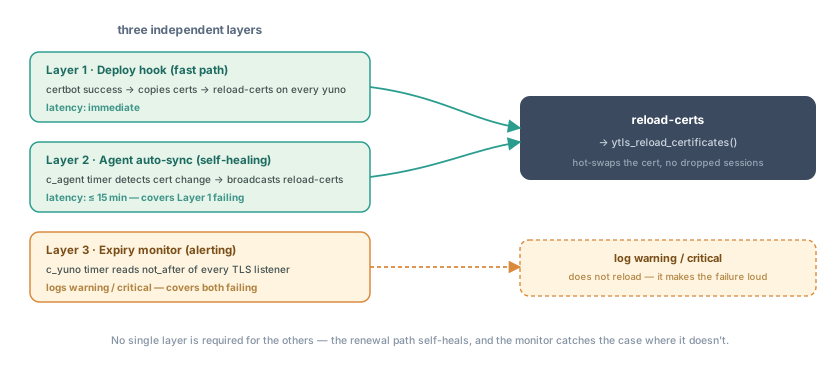
Two layers drive the reload; a third just makes a missed renewal loud. No single layer is required for the others.
| Layer | Trigger | Action | Latency |
|---|---|---|---|
| 1. Deploy hook (fast path) | certbot success | Hook copies certs, invokes reload-certs on every yuno | Immediate |
| 2. Agent auto-sync (self-healing) | Timer inside c_agent (default 15 min) | Detects cert file changes under /yuneta/store/certs/ and broadcasts reload-certs | ≤15 min |
| 3. Expiry monitor (alerting) | Timer inside c_yuno (default 1 h) | Reads not_after of every TLS listener. Logs warning / critical | Independent of renewal path |
No single layer is required for the others. Layer 2 covers layer 1 failing. Layer 3 covers both failing.
Layer 1 — deploy hook (fast path)
The .deb package (packages/deb/make-yuneta-agent-deb.sh) installs a
certbot deploy-hook at
/etc/letsencrypt/renewal-hooks/deploy/reload-certs:
Run
/yuneta/store/certs/copy-certs.shas root. This reads/etc/letsencrypt/live/*/(normallyroot:root 0700) and writes mirrored copies into/yuneta/store/certs/owned byyuneta:yuneta. The script resolves thelive/*.pemsymlinks withreadlink -fand copies withinstall -C -o yuneta -g yuneta, so the.crtmtime only bumps when the content changes — both are required:install -Cnever skips a symlink source, and a trailingchownwill leave a root/yuneta owner mismatch that re-triggers the copy on every run (spuriousreload-certsbroadcast each cert-sync tick).Reload the web server (
nginx -s reloadoropenresty -s reload).Broadcast the yuno-level
reload-certscommand to every running yuno:sudo -u yuneta -H /yuneta/bin/ycommand \ -c 'command-yuno command=reload-certs service=__yuno__'Touch
/var/lib/yuneta/last-deploy-hook-runwith a Unix timestamp so the monitor in layer 3 can detect a hook that never runs.
Each step runs independently (set +e) so one broken yuno cannot
cascade-abort the hook. All output goes to /var/log/yuneta/deploy-hook.log.
The reload-certs command chain
command-yuno command=reload-certs service=__yuno__ is routed to
c_yuno’s reload-certs handler, which walks the gobj tree and
invokes each C_TCP_S / C_UDP_S listener’s own reload-certs
command. Each listener:
Reads its current
cryptoattribute (cert paths).Calls
ytls_reload_certificates()on itsytlshandle.The ytls layer builds a fresh
SSL_CTX(or mbed-TLS state), validates it, and atomically swaps it in. Live sessions keep the old context alive via refcount. New sessions use the fresh one.
Layer 2 — agent auto-sync (self-healing)
The yuno_agent (c_agent) runs a second C_TIMER child dedicated to
cert sync. Every cert_sync_interval_sec seconds (default 900, min
30):
Invoke
cert_sync_copy_cmd(defaultsudo -n /yuneta/store/certs/copy-certs.sh). Theyunetauser hasNOPASSWD:ALLin/etc/sudoers.d/90-yunetaso the script can read/etc/letsencrypt/live/.Snapshot
size+mtimeof every*.crtundercert_sync_store_dirbefore and after the copy.If any file changed, invoke
cmd_command_yunointernally to broadcastreload-certsto every running yuno — plusgobj_command(gobj_yuno(), "reload-certs", ...)on the agent itself.Update the read-only stats attrs:
cert_sync_last_check,cert_sync_last_action,cert_sync_last_result,cert_sync_failures.
Agent commands
# Force a sync immediately, useful after a manual cert install.
ycommand -c 'cert-sync-now'

# View the current cert-sync state (including when the deploy hook
# last ran, if ever).
ycommand -c 'cert-sync-status'
cert-sync-status reads /var/lib/yuneta/last-deploy-hook-run so a
stale or missing timestamp is a direct hint that the deploy hook is
not firing.
Configurable attrs
| Attr | Default | Set by | Purpose |
|---|---|---|---|
cert_sync_enabled | 1 | config, or write-attr (persistent) | Master on/off for the timer |
cert_sync_interval_sec | 900 | config, or write-attr (persistent) | Seconds between checks (floor 30) |
cert_sync_store_dir | /yuneta/store/certs | config only | Watched directory |
cert_sync_copy_cmd | sudo -n /yuneta/store/certs/copy-certs.sh | config only | Privileged copy command, run with system() |
The command and its directory are set in the agent’s configuration only, never
at run time: up to 7.25.21 write-attr could set the command the agent runs
with system() (as root, through sudo), and persist it. A value persisted
then is no longer read; set it in /yuneta/agent/yuneta_agent.json:
{
    "global": {
        "agent.cert_sync_copy_cmd": "/usr/bin/sudo -n /yuneta/store/certs/copy-certs.sh",
        "agent.cert_sync_store_dir": "/yuneta/store/certs"
    }
}
Layer 3 — expiry monitor (alerting)
The yuno itself (c_yuno) piggy-backs on its existing
ac_timeout_periodic action. Every timeout_cert_check seconds
(default 3600, 0 disables):
Walk every descendant gobj of gclass
C_TCP_S/C_UDP_Swithuse_ssl=TRUE.Invoke each listener’s
view-certcommand, which returnsytls_get_cert_info()augmented withdays_remaining.For each listener:
days_remaining <= cert_critical_days→gobj_log_critical().days_remaining <= cert_warn_days→gobj_log_warning().
The monitor only alerts — it never triggers a reload. The auto-sync layer owns that responsibility, cleanly separating “something needs action” (alert) from “here is the action” (reload).
Configurable attrs (persistent on the yuno)
| Attr | Default | Purpose |
|---|---|---|
timeout_cert_check | 3600 | Seconds between expiry scans (0 disables) |
cert_warn_days | 7 | Warning threshold |
cert_critical_days | 2 | Critical threshold |
Yuno commands
# Walk all TLS listeners and report {subject, not_after, days_remaining, ...}
# plus an aggregate min_days_remaining.
ycommand -c 'command-yuno command=cert-expiry-status service=__yuno__'

# Trigger reload-certs on every TLS listener of this yuno (same
# handler the deploy hook uses).
ycommand -c 'command-yuno command=reload-certs service=__yuno__'
Per-listener commands
Each C_TCP_S / C_UDP_S gobj also exposes reload-certs and
view-cert directly, useful for targeting a single listener:
ycommand -c 'command-yuno command=reload-certs gobj=my_tcp_server'
ycommand -c 'command-yuno command=view-cert    gobj=my_tcp_server'
File layout and permissions
| Path | Owner | Mode | Written by |
|---|---|---|---|
/etc/letsencrypt/live/<domain>/ | root:root | 0700 | certbot |
/yuneta/store/certs/<domain>.crt | yuneta:yuneta | 0644 | copy-certs.sh |
/yuneta/store/certs/<domain>.chain | yuneta:yuneta | 0644 | copy-certs.sh |
/yuneta/store/certs/private/<domain>.key | yuneta:yuneta | 0600 | copy-certs.sh |
/yuneta/store/certs/private/ | yuneta:yuneta | 0700 | postinst |
/var/lib/yuneta/last-deploy-hook-run | root:root | 0644 | deploy hook |
/var/log/yuneta/deploy-hook.log | root:root | 0644 | deploy hook |
The yuno never reads /etc/letsencrypt/. The privileged bridge is the
copy-certs.sh script, invoked via sudo by either the deploy hook
(as root) or the agent timer (as yuneta, since yuneta has
NOPASSWD:ALL).
How live sessions survive the swap
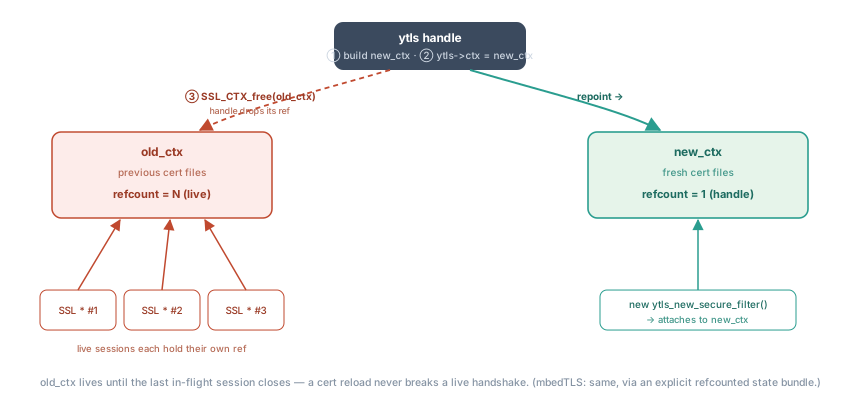
The ytls handle drops its ref on old_ctx, but each live session keeps its
own — so old_ctx outlives the swap until the last handshake on it closes.
This is the core correctness property — documented here because it is the easiest thing to break when touching the reload path.
OpenSSL backend. SSL_new(ctx) increments the SSL_CTX refcount
automatically. SSL_free(ssl) decrements it. When
ytls_reload_certificates()
runs:
Build
new_ctxwith fresh cert files.Swap
ytls->ctx = new_ctx.SSL_CTX_free(old_ctx)— drops the ytls handle’s ref.
Live SSL * objects retain their own ref on old_ctx, so the old
context lives until the last in-flight session closes. A new call to
ytls_new_secure_filter()
uses new_ctx.
mbed-TLS backend. The ytls layer maintains an explicit
mbedtls_state_t bundle (mbedtls_ssl_config + mbedtls_x509_crt +
mbedtls_pk_context) with a refcount. Each hsskt takes a ref on
creation and releases it on ytls_free_secure_filter(). The swap drops
the ytls handle’s ref. Same end result: live sessions stay valid.
Troubleshooting
Hook seems to run but certs never update. ycommand -c 'cert-sync-status'
returns deploy_hook_last_run: 0 or a stale timestamp. Check
/var/log/yuneta/deploy-hook.log — each step logs its own success /
failure line. The agent auto-sync will still pick up the new certs
within cert_sync_interval_sec, so this is an alert condition rather
than a service outage.
Reload returns -1 and nothing changes. The new cert material
failed validation — wrong key, unparseable PEM, missing file. Check
the yuno log for the SSL_CTX_use_certificate_file() FAILED,
SSL_CTX_check_private_key() FAILED or mbedtls_x509_crt_parse_file() FAILED
entries. The previous context is kept intact, so traffic is
unaffected — you can fix the source files and re-run
ycommand -c 'cert-sync-now'.
days_remaining: -5 on a listener. The cert expired 5 days ago.
Either the renewal path is completely broken or the listener is
reading a file that certbot does not manage. Compare
gobj_read_attr(listener, "crypto") against the actual renewal
source.
Tests
Five tests ship in-tree to protect the feature:
tests/c/ytls/test_cert_reload.c— swap A→B + rollback on invalid cert.tests/c/ytls/test_cert_info.c— cert introspection edge cases (short / long validity, self-signed invariant, serial shape, client-side NULL, already-expired cert).tests/c/ytls/test_cert_reload_mem.c— 1000 reloads with no live session, assertsget_cur_system_memory() == 0.tests/c/yev_loop/yev_events_tls/test_yevent_reload_live.c— one reload while a TCP session is live. The session keeps working.tests/c/yev_loop/yev_events_tls/test_yevent_reload_stress.c— 50 reloads with a live session, one echo message per iteration.
Run the full suite under valgrind for an exhaustive leak check:
valgrind --leak-check=full \
    outputs/tests/c/ytls/test_cert_reload_mem