The ideas behind Yuneta: why it is built around typed graphs of finite-state objects (GObjects) that communicate only through events, and the model that shapes every design decision in the framework.
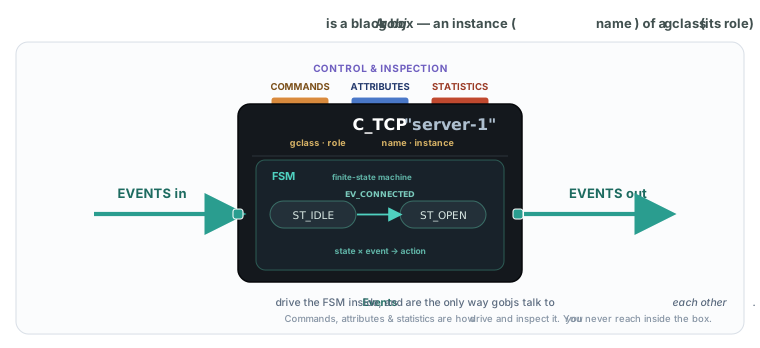
A gobj is a black box. It is an instance — identified by its
name (e.g. "server-1") — of a gclass,
the role it plays (e.g. C_TCP). Inside runs a
finite-state machine: state × event → action (an
EV_CONNECTED in ST_IDLE moves it to ST_OPEN). You never reach inside
it. Events are its communication channel: it receives them —
they drive the FSM — and it sends them, and they are the only way gobjs
talk to each other. Commands, attributes and statistics are ports on its
surface — how you drive and inspect it. There are no links here yet: how
gobjs connect into a graph comes next. → Continues in
The Typed-Graph Model.
In this section
Design Principles — the rules that keep the system simple, observable, and portable across languages.
The Typed-Graph Model — nodes, links, and the typed hierarchy that represents both runtime structure and persisted data.
Domain Model — how a problem domain maps onto yunos, gclasses, and events.
Inspiration — the prior art and motivations Yuneta draws from.