Central management point for a fleet of Yuneta nodes. Nodes dial in to the
control center (the agents are the clients). Operators then reach any connected
node through the control center. C_CONTROLCENTER is a server — it never
dials out.
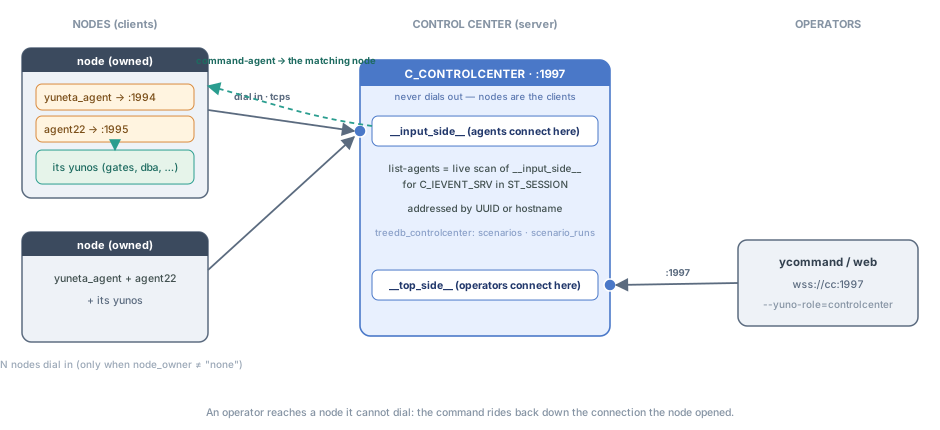
Nodes dial in to __input_side__; operators reach __top_side__. A
command-agent rides back down the connection the node opened — which is
how an operator reaches a node it could never dial directly.
How a node connects to a control center
A node connects only when it has an owner. The primary
yuneta_agent declares an outbound client service named
controlcenter (gclass C_IEVENT_CLI, chain
C_IEVENT_CLI → C_IOGATE → C_CHANNEL → C_PROT_TCP4H → C_TCP, TLS). That service
is autostart:false and is started only when node_owner ≠ "none". An
empty owner is forced to "none", so by default a node does not dial out.
To enrol a node, set its node_owner (and, if not using the default control
center, its __output_url__).
How the remote URL is built
The agent assembles the control-center URL from config variables:
tcps://(^^__sys_machine__^^).(^^__node_owner__^^).(^^__output_url__^^)that is, tcps://<machine>.<node_owner>.<output_url> where:
| Variable | Source | Example |
|---|---|---|
__sys_machine__ | uname machine | x86_64 |
__node_owner__ | the node’s node_owner | artgins |
__output_url__ | agent config (default yunetacontrol.com:1994) | yunetacontrol.com:1994 |
→ tcps://x86_64.artgins.yunetacontrol.com:1994 (TLS, default port 1994).
The secondary yuneta_agent22 dials its own endpoint,
default yunetacontrol.ovh:1995 (port 1995), and additionally exposes
remote PTY consoles that the control center drives with write-tty.
Reaching nodes through the control center (ycommand)
The control center exposes two gates (defined in its realm config, not in the
binary): __input_side__ where agents connect, and __top_side__ where
operators (web / ycommand) connect. In production there
are two control centers, one per agent plane: 1996 (the agents, fed on
1994) and 1997 (agent22, fed on 1995).
1 — point ycommand at the control center (role and service are both
controlcenter):
ycommand --url=wss://<cc-host>:1997 --yuno-role=controlcenter --yuno-service=controlcenter -c 'list-agents'or, through an agent that already holds the control-center connection, with the
passthrough form shipped in the controlcenter README:
ycommand -c 'command-yuno id=<cc> service=controlcenter command=list-agents'2 — list the connected nodes with list-agents (UUID, hostname, status).
Connected nodes are discovered live: the control center scans __input_side__
for C_IEVENT_SRV children in state ST_SESSION and reads each one’s
identity_card — a node is addressed by its UUID (identity_card.id) or
its hostname.
3 — forward a command to one node with command-agent (a SDF_WILD_CMD):
ycommand -w 10 -c 'command-yuno id=<cc> service=controlcenter command=command-agent agent_id=<host-or-uuid> cmd2agent="list-yunos"'Parameters: agent_id (UUID or hostname), agent_service, and cmd2agent
(the command to run on the node — this is the exact key the handler reads). The
control center routes the command to the one matching connected agent
(gobj_command, first match only). The node’s agent then executes it, and can
itself target a specific yuno via its own command-yuno (command=… service=…).
command-agent answers AT ONCE, before the node does: the first answer is
the control center’s own, “Command sent to 1 nodes” (or “... to 0 nodes”
when no connected agent matches). The node’s answer comes later, as a second
answer along the same route. A non-interactive ycommand exits --wait
seconds after an answer (-w, default 1), so it shows the node’s answer only
if it arrives in that time. Give it room, or stay interactive (-i):
ycommand -w 10 -c 'command-yuno id=<cc> service=controlcenter command=command-agent agent_id=<host-or-uuid> cmd2agent="list-yunos"'Events pushed by a node, relayed to the web client
Some of what a node’s agent sends is not an answer but a stream, pushed along
the route of the request that opened it: the PTY of open-console
(EV_TTY_OPEN, EV_TTY_DATA, EV_TTY_CLOSE) and, since 7.25.13, the stats
of a watch-yuno-stats (EV_YUNO_STATS). The control center relays each of
them to the web client at the end of the route. It must KNOW the event: a
control center that receives one it does not know drops the agent’s
connection. And the client at the end must know it too: ycommand logs
“Event NOT DEFINED” on every reading. So the web client says it takes the
event, in its request:
{"agent_id": "node1",
 "cmd2agent": "watch-yuno-stats ids=2120,5120 period=2000",
 "__relays__": ["EV_YUNO_STATS"]}
command-agent removes the client’s __relays__ and, only if it named
EV_YUNO_STATS, writes its own __relays__: ["EV_YUNO_STATS"] in the kw it
forwards (the client’s other entries are not passed on). The agent refuses a
watch without it (“the client, or the control center in between, does not say
it takes EV_YUNO_STATS (relays), ask stats-yuno instead”), and the client
polls stats-yuno. Up to 7.25.20 the control center said it for every client,
so a ycommand watch through it got readings it could not handle.
Deploy order: gui_agent 0.29.7 or later first, or together with this
control center. An older gui_agent does not send __relays__ through the
control center: its Monitor is refused the watch and polls instead, the same
fallback it takes with an agent that refuses a direct watch.
Who gets what the agent sends back is the requester named in the control
center’s OWN hop of the route: the web client’s channel of __top_side__, or
the control center’s link to its own agent (agent_client, a C_IEVENT_CLI)
for a request made through the local agent (it is answered twice, see
above: -w gives the node’s answer time to arrive):
ycommand -w 10 -c 'command-yuno id=<cc> service=controlcenter command=command-agent agent_id=node1 cmd2agent="list-yunos"'That link is believed only for an agent it asked: the agent’s channel remembers the links whose requests it was sent, and forgets them when it closes. An agent that routes an answer to a link that never asked it is dropped with the same warning.
A route that names anything else is dropped with the warning “answer of an agent for no requester of this control center, dropped” (the PTY output with “PTY output of an agent for no requester of this control center, dropped”, once a minute). Up to 7.25.20 it fell back to a service named by the hop below, which the client writes, so the answers of a request through the local agent were sent to the control center itself and lost.
An event that only an agent sends, sent by a web client from __top_side__,
is dropped: “event of an agent not from the agents’ side, dropped”, at most
once a minute, with dropped= counting the ones since the last warning.
A stats reading for a web client that is gone (a closed tab) is expected -- the agent learns it only when the watch expires, not renewed -- and is counted, not logged per reading: one warning a minute at most,
yuno stats for a web client that is gone, dropped (the agent's watch expires) dropped=42Each capped warning (this one, the PTY of a client that is gone, PTY output
routed to nobody, agent events sent by a web client) says what it counted when
it speaks next. So the count left since the last one is said when its window
ends, or when the control center stops, with when:
stream for a web client that is gone, dropped when="its window ended" dropped=17The window is the attribute drops_warning_window, in milliseconds (default
60000: one warning a minute per kind). A new value applies at once to the
windows that are open, and a value under 1 is refused (logged, 60000 put
back). drops_timer_armed (read-only) says whether a count is waiting for its
window to end:
ycommand -c 'command-yuno id=<cc> service=__yuno__ command=write-attr gobj_name=controlcenter attribute=drops_warning_window value=10000'
ycommand -c 'command-yuno id=<cc> service=__yuno__ command=view-attrs gobj_name=controlcenter attribute=drops_timer_armed'
Not when a connection closes: a client that connects, sends one, and leaves, in a loop, would get one warning per loop.
A web client is its CONNECTION, not its channel name (since 7.25.15).
The channel a browser holds in __top_side__ (top-12) is taken by the next
client once it closes, so a stream still pushed for the tab that left would
reach whoever connected after it -- up to watch_ttl of another user’s node
data. Each connection gets a number when it opens, command-agent and
stats-agent stamp it on the request (cc_connection, in the first frame of
the ievent stack, which the agent gives back with its answer and keeps with a
watch or a console), and what comes back -- the answer of a command or of a
stats, the PTY of open-console (EV_TTY_OPEN, EV_TTY_DATA,
EV_TTY_CLOSE), a relayed EV_YUNO_STATS, the answer of a run-scenario --
is delivered only while the channel still holds that connection. A stream
(EV_YUNO_STATS, EV_TTY_DATA) for another connection is dropped and counted
with the gone ones (reconnected=its channel holds another connection now in
the warning); an answer is dropped with a warning each (“answer for a web
client that is gone, dropped: its channel holds another connection now”).
When an agent’s connection closes, the client of each console mirrored
through it is dropped, once, and only if it is still the connection that
opened that console. Several consoles go through one agent’s connection; the
control center keeps their clients per console name, and a console opened
again by another client is that client’s -- the agent routes it the same way
(one route per console and control-center channel, refreshed by the re-open).
Up to 7.25.20 the control center kept one client per agent connection: the
last console opened, cleared by the close of any console. Up to 7.25.20 only
EV_YUNO_STATS and the run’s answer were checked: a slow answer, or a PTY
stream, of the client that left reached the next one.
These events are public because the agents send them, but only an agent may:
one that arrives from __top_side__ -- a web client sending it itself, with a
route of its own writing -- is dropped with a warning (“event of an agent
not from the agents’ side, dropped”). Up to 7.25.20 a client could push an
answer or console frames of its making to any other client’s channel.
Scenarios (TreeDB)
The control center’s treedb, treedb_controlcenter (schema_version 3),
keeps the scenarios of the fleet and the runs of their actions. It
holds neither the connected nodes (discovered live, above) nor the users (who
may use the control center is its authz store, C_AUTHZ).
                      scenarios
            ┌───────────────────────────┐
            │* id                       │
            │  description, group       │
            │  node, agent_url          │
            │  yunos, links             │
            │  actions, view            │
            │                   runs {} │ ◀─┐
            │  created_by/at            │   │
            │  updated_by/at            │   │
            └───────────────────────────┘   │
                    scenario_runs           │
            ┌───────────────────────────┐   │
            │* id                       │   │
            │           scenario_id (↖) │ ──┘
            │  action, username         │
            │  started_at, ended_at     │
            │  result, comment, steps   │
            └───────────────────────────┘
A scenario is a set of yunos on one or several nodes, how the messages flow between them, and the commands of each action -- a test to run and watch, or just a group of yunos to watch. It is a document saved whole:
{
    "id": "yunovatios-stress",
    "description": "sim_controllers -> gate_central -> db_tracks_ce",
    "group": "yunovatios",
    "node": "yunovatios-controlador",
    "yunos": [
        {"key": "sim",    "id": "stress", "service": "sim_controllers", "rate": "tx"},
        {"key": "gate",   "id": "2120",   "label": "gate_central"},
        {"key": "tracks", "id": "5120",   "label": "db_tracks_ce"}
    ],
    "links": [["sim", "gate"], ["gate", "tracks"]],
    "actions": {
        "start":  [{"yuno": "sim", "command": "set-controllers controllers=10"},
                   {"yuno": "sim", "command": "resume-generation"}],
        "stop":   [{"yuno": "sim", "command": "set-controllers controllers=0"}],
        "report": [{"yuno": "gate", "service": "__yuno__", "command": "view-config"}]
    },
    "view": {"mode": "graph"}
}| Key | Meaning |
|---|---|
id | The scenario’s name: no blanks, no ^, no `. |
node | The node (agent hostname or UUID) of every yuno that does not say its own. |
agent_url | Instead of node: a DIRECT scenario, watched by the web console through its own link to that agent. run-scenario refuses it. |
yunos | id (the agent’s yuno id) and optionally key (how the rest of the scenario names it, needed when two nodes carry the same id), node, service, label, rate (rx or tx). |
links | [from, to] pairs of keys: how the messages flow. |
actions | start, pause, resume, stop, report: each a list of steps {yuno, service?, command}, one command line with its key=value parameters. |
view | How the console shows it (mode: graph or cards). |
save-scenario validates it -- the same rules the console’s editor applies --
and writes every column: a key the new document leaves out is emptied, not
kept.
Two editors of one scenario (since 7.25.16). scenarios answers each
scenario with its treedb metadata, and its __md_treedb__.g_rowid is the
REVISION it was read at: every save moves it. Sent back as revision=, a save
over a scenario somebody saved (or deleted) since is refused, naming who, and
the editor reads it again instead of the last writer silently winning.
Without revision (or with 0) there is no check: a new scenario, or an
overwrite asked for on purpose. updated_at is not used for this: it counts
seconds, and two saves in one second look the same.
ycommand ... -c 'scenarios scenario_id=t1'                # ... "__md_treedb__": {"g_rowid": 7, ...}
ycommand ... -c 'save-scenario revision=7 scenario={...}' # saved: the answer carries g_rowid 8
ycommand ... -c 'save-scenario revision=7 scenario={...}' # -> scenario 't1' was saved by ana since you read it (revision 8, yours 7): read it again
ycommand --url=wss://<cc-host>:1996 --yuno-role=controlcenter --yuno-service=controlcenter \
-c 'save-scenario scenario={"id":"t1","node":"wattyzer","yunos":[{"id":"1620"}],"actions":{"report":[{"yuno":"1620","command":"help"}]}}'
ycommand ... -c 'scenarios'
ycommand ... -c 'scenarios scenario_id=t1'
ycommand ... -c 'delete-scenario scenario_id=t1' # and its runsRunning an action. run-scenario scenario_id=<id> action=<action> sends
each step, in order, to the yuno’s node as
command-yuno id=<yuno> [service=<service>] command=<command>carrying the user who asked (__username__, what the agent’s audit records).
A step goes only when the one before it answered; a step that fails, does not
answer in run_step_timeout (30000 ms), or whose node’s agent disconnects
meanwhile, ends the run there -- the last at once, not at the deadline. The run is written to scenario_runs -- action, user, start and
end, the result and the answer of every step, and for a report what each
step answered (data) -- and the requester is answered with it (the command
answers when the run is OVER). One run at a time.
A step is marked in its __md_iev__ (cc_run, cc_step) and its answer is
taken only from the channel of the agent it went to: command-agent removes
those two keys from what a client forwards, and an answer that carries them
from anywhere else is dropped with a warning (“answer of a scenario run step
not from the agent of the step, dropped”). Up to 7.25.20 a client with
command-agent could end, or advance, another user’s run with an answer of
its own.
ycommand ... -c 'run-scenario scenario_id=t1 action=report'
ycommand ... -c 'scenario-runs scenario_id=t1'        # newest first
The parameter is scenario_id, never id: reached through an agent’s
command-yuno, the whole kw is the filter that picks the yuno, and there id
is the yuno’s.
The permissions read-scenarios, write-scenarios and run-scenarios are
checked by the commands themselves, always -- not only when the yuno turns
enable_command_authz on. The agent runs each step on the control center’s
own session, so write-scenarios together with run-scenarios is as much
as command-agent: whoever may write a scenario and run it may send any
command to any yuno of a connected node. Grant them as you grant
command-agent.
What a step may carry. A scenario id is letters, digits and _ . @ -, not
starting with a dot, 200 characters at most (a run id is <id>.<ms>). The
id, key and service of a yuno, and the service of a step, are letters,
digits and _ . ^ -. A step’s command is a name and key=value parameters
without blanks, and a parameter may NOT be named like a parameter of
command-yuno (id, service, command) or like a column of the agent’s
yunos topic (yuno_name, date, global, realm_id, ...): the agent takes
the whole kw of command-yuno as the filter that selects the yuno, so such a
parameter would pick another yuno or none. save-scenario refuses it:
ycommand ... -c 'save-scenario scenario={"id":"t2","node":"wattyzer","yunos":[{"id":"1620"}],"actions":{"stop":[{"yuno":"1620","command":"set-x date=1"}]}}'
# -> ... actions.stop[0]: command: the parameter 'date' is command-yuno's or a yuno's field: it would select the yuno
Nor may a parameter start with __ (__md_iev__, __username__,
__md_command__, ...): those are the framework’s keys, and the agent’s command
parser sets the parameters of the line over the kw -- a __md_iev__ would
replace the routing of the step’s answer (the run waits for its deadline), a
__username__ the user the control center stamps.
ycommand ... -c 'save-scenario scenario={"id":"t3","node":"wattyzer","yunos":[{"id":"1620"}],"actions":{"stop":[{"yuno":"1620","command":"set-x __username__=root"}]}}'
# -> ... actions.stop[0]: command: the parameter '__username__' is a framework key: it would replace what the control center sets
run-scenario checks the steps of the action again before it sends the first
one, so a scenario saved before a check existed (by 7.25.14, which checked no
step) is refused by name until it is saved again:
ycommand ... -c 'run-scenario scenario_id=t1 action=stop'
# -> ... cannot run 'stop' of 't1': step 0: command: the parameter 'date' is command-yuno's or a yuno's field: it would select the yuno; save the scenario againConfiguration
The yuno composes authz (C_AUTHZ) + controlcenter (C_CONTROLCENTER,
default service). Authz.max_sessions_per_user defaults to 4. Key attributes:
| Attribute | Purpose |
|---|---|
run_step_timeout | Milliseconds a step of a scenario run may take to answer (30000) |
drops_warning_window | Milliseconds of the window of a capped warning (60000) |
timeout | Period of the rate tick, ms (1000): rxMsgsec/txMsgsec and their maxima |
The listen URLs/ports live in the realm config (__top_side__ /
__input_side__), not in the binary. Neither side is autostarted nor
autoplayed: the control center starts both in its mt_play, where it
subscribes to them, and stops them in its mt_pause. An autostarted
__input_side__ listens from the yuno’s start (C_TCP_S listens in its
mt_start), so an agent that connects to a control center run with play=0
logs “Publish event WITHOUT subscribers”, and a paused control center
accepts agents.
{
    "name": "__input_side__",
    "gclass": "C_IOGATE",
    "autostart": false,
    "autoplay": false,
    "kw": {"persistent_channels": false}
}Stats
The messages it relays, counted once each way:
rxMsgs, in: a client’scommand-agent,stats-agent,write-ttyandrun-scenario, and every answer or stream an agent sends (command and stats answers, the console PTY,EV_YUNO_STATS, a run step’s answer);txMsgs, out: eachcommand-agent/stats-agent/write-ttyrequest sent to an agent and each step of a run, and each answer or stream relayed to a client, the answer of a run included.
rxMsgsec/txMsgsec are their rates in messages by second, computed on a
tick every timeout ms (1000) over the EXACT interval since the previous
tick: a reading only returns the last tick’s value, so it is the same
whoever reads and however often. maxrxMsgsec/maxtxMsgsec keep the highest
rate of any tick, a burst nobody read included; write 0 to start them again.
stats=__reset__ zeroes the counters, the rates and the maxima. drops_timer_armed says whether a capped
warning has a count waiting for its window.
The tick is a real period (a C_TIMER0, io_uring), and runs only while the
control center plays: paused, the rates read 0. A timeout under 1 ms, in the
config or written, is refused with an ERROR and 1000 is put back. Up to
7.25.21 the tick was a C_TIMER, which checks its deadline on the yuno’s
timeout_periodic (1000 ms) and re-arms from when it was served, so a tick of
1000 came every 1 or 2 s and a burst of one second in a tick of two was halved
in the maxima; a timeout under 1 in the config was not checked (the tick was
off and the rates read 0), and paused, the rates kept the last tick’s value.
ycommand -c 'stats-yuno id=<cc> service=controlcenter'
# ... "rxMsgs": 1520, "txMsgs": 1519, "rxMsgsec": 12, "txMsgsec": 12, "maxrxMsgsec": 140, ...
Up to 7.25.20 nothing counted them and the tick that computed the rates was never armed: all six read 0.
Commands
| Command | Description |
|---|---|
list-agents | List currently connected nodes (UUID, hostname, status) |
command-agent | Forward a command to one node (agent_id, agent_service, cmd2agent) |
stats-agent | Fetch stats from a node |
drop-agent | Drop a node’s connection |
write-tty | Write to a node’s PTY console (via agent22) |
logout-user | Log out a user session |
scenarios | List the scenarios, or one (scenario_id) |
save-scenario | Create or replace a scenario (scenario) |
delete-scenario | Delete a scenario and its runs (scenario_id) |
run-scenario | Run the steps of an action, in order (scenario_id, action) |
scenario-runs | The runs of a scenario, newest first (scenario_id) |
authzs | Authorization help |
help | Command help |
Ports
| Port | Used by |
|---|---|
1991 | Agent local plaintext control plane (ws://127.0.0.1:1991) |
1993 | Agent secure control plane (wss://0.0.0.0:1993) |
1994 | Primary agent → control center (default __output_url__) |
1995 | agent22 → control center |
1996 | Control center listener, agents plane (production realm config) |
1997 | Control center listener, agent22 plane (production realm config) |
1992 | UDP log sink |
Debugging
| GClass | Level | Shows |
|---|---|---|
C_CONTROLCENTER | messages | Message flow |