ytls.h
The ytls.h header file defines the interface for the TLS (Transport Layer Security) function in the Yuneta framework. It provides function declarations and structures for handling secure communication using TLS. Key features include:
Initialization & Cleanup: Functions to initialize and clean up TLS resources.
TLS Context Management: Creation and management of TLS contexts for secure communication.
Certificate Handling: Functions for setting up and managing SSL certificates and private keys.
Secure Data Transmission: Functions for sending and receiving encrypted data over TLS connections.
Error Handling & Debugging: Utilities for logging and debugging TLS-related issues.
Architecture
The ytls module uses a backend-agnostic design. The public API (ytls.h / ytls.c) exposes a single api_tls_t dispatch table, while the actual crypto is provided by two interchangeable backends configured via Kconfig (one or both can be enabled):
OpenSSL (
CONFIG_HAVE_OPENSSL) — default, full-featured TLS backend.mbed-TLS (
CONFIG_HAVE_MBEDTLS) — lightweight alternative that produces ~3x smaller static binaries.
Both backends can be enabled simultaneously. When both are present, OpenSSL is preferred as the default.
ytls.h is the single source of truth for the backend names:
TLS_LIBRARY_NAME— preferred backend ("openssl"when both are enabled).TLS_LIBRARIES_NAME— every backend compiled in, joined with+(for example"openssl+mbedtls").
At runtime, two matching yuno global variables are available — root-linux’s yunetas_register_c_core() publishes them into gobj’s global-variable pool via gobj_add_global_variable(), so gobj-c itself stays free of any CONFIG_HAVE_OPENSSL / CONFIG_HAVE_MBEDTLS checks:
__tls_library__— preferred backend, used for(^^__tls_library__^^)substitution in kw configs.__tls_libraries__— all enabled backends, useful for diagnostics and logging.
Source files
| File | Purpose |
|---|---|
ytls.h / ytls.c | Public API and dispatch table |
tls/openssl.c / openssl.h | OpenSSL backend implementation |
tls/mbedtls.c / mbedtls.h | mbed-TLS backend implementation |
Backend implementations
Both backends implement the same function:
TLS Context Setup: Creating, configuring, and destroying TLS contexts.
Certificate Loading: Loading certificates, verifying them, and handling private keys.
Connection Handling: Establishing, reading, writing, and closing TLS-secured connections.
Error Reporting: Logging and handling backend-specific errors.
Secure Communication: Encrypting and decrypting data sent over a TLS connection.
Password Hashing: Both backends use PBKDF2-HMAC (RFC 2898) and produce bit-for-bit identical output, so user/password databases are fully portable between backends.
This module makes sure that Yuneta applications can securely transmit data over the network using industry-standard encryption protocols.
Hot-reloading certificates
ytls can swap the certificate material of a running TLS listener without
dropping the sessions that are already established. This is how Yuneta
keeps MQTT brokers, intake gates and control-plane channels online while
Let’s Encrypt renews a certificate in the background.
API
ytls_reload_certificates()
is the only entry point. It rebuilds the per-backend context from the cert
paths already stored in the ytls handle, validates it, and atomically
swaps it in. If any step fails, the previous context is kept intact and the
caller sees a negative return — traffic is never interrupted by a bad
reload.
ytls_get_cert_info() returns
subject, issuer, not_before, not_after, serial and
days_remaining for the currently-active context, so operators can observe
the live cert (not just the file on disk).
How live sessions survive the swap
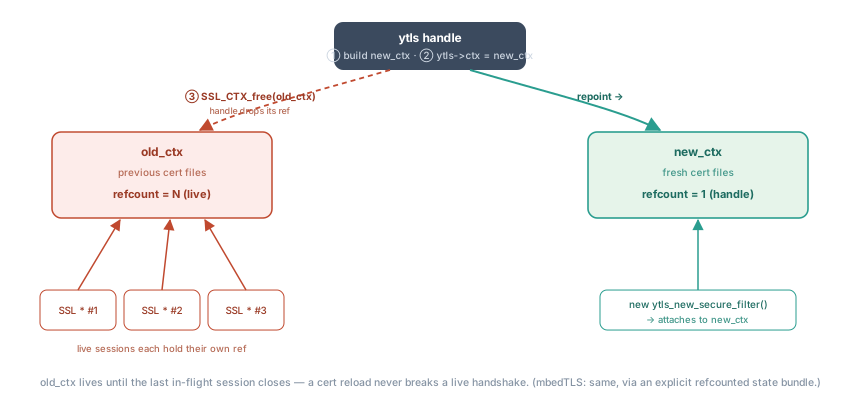
The handle drops its ref on old_ctx; live sessions keep theirs, so the old
context outlives the swap.
The invariant is: live sessions hold their own reference on the old context, so the swap only drops the handle’s reference. This is the easiest thing to break when touching the reload path.
OpenSSL backend.
SSL_new(ctx)bumps theSSL_CTXrefcount,SSL_free(ssl)decrements it.ytls_reload_certificates()buildsnew_ctx, swapsytls->ctx = new_ctxand callsSSL_CTX_free(old_ctx)to release the handle’s ref. In-flightSSL *objects keepold_ctxalive until the last session closes.mbed-TLS backend.
ytlsmaintains an explicitmbedtls_state_tbundle (mbedtls_ssl_config+mbedtls_x509_crt+mbedtls_pk_context) with a refcount. Eachhsskttakes a ref on creation and releases it onytls_free_secure_filter(). The swap drops the handle’s ref. Live sessions keep the old bundle alive on their own.
Callers
Yuneta ships three layers of defense that all drive
ytls_reload_certificates() through the same path — see the
TLS certificate management guide for the full
picture:
Layer 1 — certbot deploy hook. Pushes the
reload-certscommand down the yuno tree the moment certbot succeeds.Layer 2 —
c_agentauto-sync timer. Re-reads the cert files everycert_sync_interval_secseconds (default 15 min) and broadcastsreload-certswhensize+mtimechanges.Layer 3 —
c_yunoexpiry monitor. Periodicview-certwalk with warning / critical thresholds (cert_warn_days,cert_critical_days). It only alerts, and it never reloads.
Each C_TCP_S / C_UDP_S listener also exposes reload-certs and
view-cert directly, so a single listener can be targeted from
ycommand without touching the rest of the yuno.
TLS security posture (hardening)
ytls is secure-by-default: a gate that sets no TLS knobs gets the hardened
behavior, and every deliberate relaxation is an explicit, logged downgrade —
the yuneta “no silent errors” axiom applied to crypto. The knobs below live in
the gate’s crypto config. The same key means the same thing on both backends.
Protocol floor — ssl_min_version
Both backends floor at TLS 1.2 when ssl_min_version is unset.
OpenSSL accepts
SSLv3/TLS1.0/TLS1.1/TLS1.2/TLS1.3. A floor below TLS 1.2 is the IoT/legacy escape hatch: it must be paired withssl_ciphers "@SECLEVEL=0"for OpenSSL to negotiate the old suite, and it logs a warning at context build (“legacy floor below TLS1.2 / IoT-compat downgrade”) so downgraded gates stay enumerable in the logs.mbed-TLS accepts only
TLS1.2/TLS1.3— it can raise the floor, never lower it. Legacy peers must use the OpenSSL backend.A peer offering a version below the floor is rejected, and the rejected handshake is logged by default (not only under
trace_tls) inytls_do_handshake().
Renegotiation — ssl_disable_renegotiation
Defaults to true (renegotiation disabled), closing the renegotiation-based
DoS/abuse surface. TLS 1.3 has no renegotiation at all. Set it to false only on
a gate that genuinely needs it — that re-enable is logged as an auditable
downgrade. OpenSSL backend only.
Peer verification — ssl_verify_mode
When unset, the mode is computed from the gate’s role and whether a CA is configured:
| Situation | Computed default |
|---|---|
| server, no CA configured | none — preserves historical IoT / PSK / self-signed behavior (anonymous clients accepted) |
| client, no CA configured | refused — see verify-by-default below |
| server with a CA | optional — request + verify the client cert if presented |
| client with a CA | required — validate the server cert + hostname |
ssl_verify_mode (required / optional / none) overrides the computed
default. ssl_use_system_ca adds the OS trust store. ssl_verify_depth bounds
the chain. A verify failure is never silent: under optional a non-verifying
peer is accepted but logged post-handshake (OpenSSL SSL_get_verify_result(),
mbed-TLS mbedtls_ssl_get_verify_result()). Under required the verify callback
logs the chain error and aborts the handshake. The mbed-TLS verify default is
deliberately left IoT-tolerant (optional, surfaced) — raise it per gate with
ssl_verify_mode=required.
Verify-by-default for clients (since 7.6.0)
A TLS client with no way to validate the server certificate (effective
authmode none — no CA configured, or an explicit ssl_verify_mode=none) is a
standing MITM hole, so it is now refused at ctx/state build time in both
backends: ytls_init() fails and the connection is not made (fail-soft — the
yuno stays up). This is a breaking change for clients that previously ran
unverified. To keep running such a client (self-signed / PSK / IoT bring-up) set
ssl_allow_insecure_client: true in its crypto block to accept the MITM risk
explicitly. The choice is then logged, never silent (the mbed-TLS backend runs
the opted-in client under optional so the tolerated verify failure is still
surfaced — OpenSSL parity). Servers with no CA legitimately accept anonymous
clients and are unaffected.
Knob summary
| Knob | Default | Effect |
|---|---|---|
ssl_min_version | TLS 1.2 floor | minimum negotiated protocol version |
ssl_disable_renegotiation | true | OpenSSL renegotiation off |
ssl_verify_mode | computed (table above) | required / optional / none |
ssl_trusted_certificate | unset | path to a CA bundle (PEM) used to verify the peer |
ssl_use_system_ca | false | also trust the OS CA store (OpenSSL only) |
ssl_verify_depth | 2 | max certificate chain depth (leaf → intermediate → root) |
ssl_allow_insecure_client | false | true → run an unverified client anyway (accept the MITM risk) |
ssl_ciphers | backend default | cipher list (@SECLEVEL=0 to reach legacy suites) |
Regression coverage:
test_tls_floor_openssl.c
asserts that an explicit sub-TLS1.2 floor is logged and that a real TLS1.0
ClientHello is rejected by the default floor.
test_tls_verify_openssl.c
drives a real client/server handshake and asserts that a trusted cert with a
matching host connects, while a hostname mismatch or an unknown CA is rejected.
Deployment — gate profiles & rollout
Secure-by-default means the upgrade itself breaks nothing: modern peers keep
negotiating on the new TLS 1.2 floor, renegotiation-off is transparent, and peer
verification stays off on any gate until you give it a CA. Hardening a gate is
then just a few keys in its crypto config. Two profiles cover almost every
gate.
Profile A — high-security gate
For SPA / BFF front ends, host-to-host links and the control plane — gates that
talk to modern peers. Turn verification on. The floor, reneg-off and the
computed required/optional mode are already the defaults, so the CA is the
only thing you add.
A client that dials out (validates the server it connects to):
"crypto": {
    "library": "openssl",
    "ssl_trusted_certificate": "/yuneta/store/.../trusted_ca.pem",
    "ssl_server_name": "api.example.com"
}ssl_server_nameis mandatory here: without it the chain is verified but the hostname is not (the gate logs a warning). It doubles as the SNI sent in the ClientHello.For a public endpoint, drop
ssl_trusted_certificateand set"ssl_use_system_ca": trueto trust the OS store instead.
The bundled CLI tools (ycommand, ystats, ybatch, ytests, ycli,
mqtt_tui, emu_device) already pass "ssl_use_system_ca": true on their
outbound TLS, so a wss:// / https:// endpoint with a public CA
(for example Let’s Encrypt) works by default — including ycommand’s OIDC task-authenticate
to the issuer. ycommand, ybatch and ystats expose --ssl-use-system-ca
(default on), --ssl-trusted-certificate (private CA), --ssl-server-name
and --ssl-allow-insecure-client (bypass) to override per call. ycli takes
the same four as parameters of its connect command.
Verification checks the hostname too, so dial the name the certificate is
issued for, not any DNS alias that resolves to the same host. When you cannot
— a pinned certificate that carries a name of its own — give that name in
--ssl-server-name. The agent is the case in point: it serves one long-life
certificate of its own (CN=yuneta_agent.yuneta.io) on every node, so the
name never matches the host dialed:
ycommand -u wss://node.example.com:1993 \
    --ssl-trusted-certificate=/yuneta/agent/certs/yuneta_agent.crt \
    --ssl-server-name=yuneta_agent.yuneta.io \
    -c 'list-yunos'
Nothing is weakened: the chain is still validated against the PEM given, and
--ssl-server-name only says which name to check it against. Without it the
handshake is rejected for a hostname mismatch, and the tool retries in
silence instead of failing — the flag is the difference between a working
call and a command that seems to hang.
A server doing mutual-TLS (validates the client certificate):
"crypto": {
    "library": "openssl",
    "ssl_certificate": "/path/server.pem",
    "ssl_certificate_key": "/path/server.key",
    "ssl_trusted_certificate": "/path/client_ca.pem",
    "ssl_verify_mode": "required"
}
A CA-configured server defaults to optional (request + verify the client cert
if presented, tolerate absent). Set required to reject clients without a valid
certificate.
Profile B — IoT / legacy-compat gate
For old devices that cannot do TLS 1.2, or that use PSK / self-signed certs. Relax explicitly — each relaxation is logged and stays greppable.
"crypto": {
    "library": "openssl",
    "ssl_min_version": "TLS1.0",
    "ssl_ciphers": "HIGH:@SECLEVEL=0",
    "ssl_verify_mode": "none"
}
Legacy floors are OpenSSL only — mbed-TLS cannot negotiate below TLS 1.2, so legacy gates must use the OpenSSL backend.
@SECLEVEL=0is required for OpenSSL to offer the old cipher suites.ssl_min_versionalone is not enough.Keep this profile on the narrowest possible set of gates. Everything else stays on Profile A / the defaults.
Rollout procedure
Upgrade. Nothing breaks. The reduced-security gates start announcing themselves in the log.
Enumerate from the logs. Every gap is designed to be greppable:
Log message Meaning Action TLS client WITHOUT server-certificate validationa client is not validating the server it dials add a CA → Profile A TLS handshake rejecteda peer was refused (often a legacy device below the floor) if legitimate, move that gate to Profile B legacy floor below TLS1.2a gate is on a relaxed floor confirm it is an intended IoT gate renegotiation explicitly enableda gate re-enabled renegotiation confirm it is needed peer certificate did NOT verifyan optionalgate accepted an invalid certfix the chain, or raise to requiredHarden the high-level gates one at a time: apply Profile A, restart, confirm the warning is gone and traffic still flows.
Pin the legacy gates that showed
TLS handshake rejectedto Profile B.Validate in staging, then production. Roll the config to a staging environment first and watch the same logs. Only then promote to production.
Goal state: no WITHOUT server-certificate validation lines outside known IoT
gates, and every legacy floor / renegotiation enabled line traceable to a
deliberate Profile-B gate.
Philosophy of ytls
The ytls module is built with the core philosophy of Yuneta in mind:
Security as a Priority: Ensuring that all data transmitted over the network is encrypted and protected from eavesdropping or tampering.
Backend Agnosticism: Abstracting the TLS backend behind a dispatch table so the rest of the codebase never depends on a specific crypto library. Switching between OpenSSL and mbed-TLS requires only a Kconfig change and rebuild.
Minimalism and Efficiency: A small, efficient implementation that integrates with the Yuneta framework. Choose mbed-TLS for smaller binaries on embedded/edge deployments.
Reliability & Stability: Both OpenSSL and mbed-TLS are well-tested, industry-standard cryptographic libraries.
Flexibility: Allowing customization of TLS parameters, certificates, and cipher suites to meet diverse application needs.
Ease of Use: Abstracting complex TLS operations while giving developers a simple and consistent API for secure communication.
By following these principles, ytls makes sure that Yuneta-based applications maintain strong security without unnecessary complexity.